





share
α-Ketoglutaric Acid Monosodium Salt CAS NO 22202-68-2
Unit Price:
CAS No.:22202-68-2
Grade:Customizable
Content:Customizable
Brand:Customizable
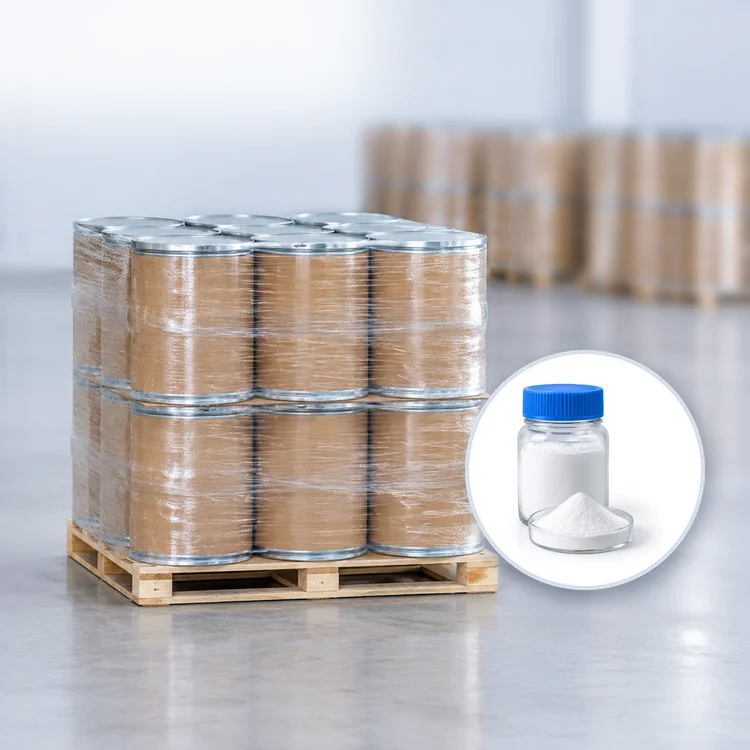
Packaging:Customizable
Description
α-Ketoglutaric Acid Monosodium Salt (CAS 22202-68-2) is the monosodium salt of α-ketoglutaric acid, a five-carbon dicarboxylic keto acid of the tricarboxylic acid cycle. It is recorded as a fine white powder. As a salt of a diacid bearing one ketone and two carboxylic acid groups, it is expected to be freely water-soluble and to exist in aqueous solution as a mixture of ionized species whose distribution depends on pH. Its keto acid and carboxylate functionality supports acid-base buffering and metal-ion chelation, giving it the role of a biochemical reagent and buffer component in laboratory and biochemical systems. In biochemical and analytical laboratory work, it serves as a defined reagent for solution preparation, assay development, and studies of keto acid chemistry.
In laboratory and biochemical production workflows, α-Ketoglutaric Acid Monosodium Salt serves as a weighed reagent during batch preparation of buffers, media, and analytical standard solutions. The resulting prepared solutions are used in biochemical research, analytical testing, and cell culture work for pH control, substrate supply, and calibration functions.
Application
- Buffer and solution preparation: In biochemical laboratory work, α-Ketoglutaric Acid Monosodium Salt serves as a buffering and ionic-strength component, where its carboxylate groups contribute to pH control in aqueous solution. The resulting buffer solutions are used in analytical and biochemical procedures requiring defined ionic conditions.
- Cell culture and media formulation: In cell culture media formulation, α-Ketoglutaric Acid Monosodium Salt serves as a supplement and nutrient source, where its keto acid structure contributes to carbon and nitrogen metabolism support. The resulting media are used in laboratory cell culture and biochemical research.
- Analytical standard and calibration preparation: In analytical chemistry, α-Ketoglutaric Acid Monosodium Salt serves as a reference compound for preparing calibration solutions, where its defined salt form contributes to consistent standard concentrations. The resulting standards are used in chromatographic and enzymatic assay calibration.
- Enzymatic assay development: In enzymatic assay development, α-Ketoglutaric Acid Monosodium Salt serves as a substrate or co-substrate in reactions involving transaminases and dehydrogenases, where its keto group participates in the corresponding conversion. The resulting assay systems are used in biochemical research and clinical-chemistry method development.
- Metal-ion chelation studies: In laboratory chelation studies, α-Ketoglutaric Acid Monosodium Salt may be evaluated as a chelating ligand, where its carboxylate and keto groups support coordination with metal ions. The resulting complexes are examined in coordination and bioinorganic chemistry research.
- Chemical derivatization research: In analytical derivatization research, α-Ketoglutaric Acid Monosodium Salt may be evaluated as a keto acid source, where its ketone group supports derivatization reactions for detection. The resulting derivatives are examined in method development studies.
Basic Information
| Property | Value |
|---|---|
| Product Name | α-Ketoglutaric Acid Monosodium Salt |
| CAS No. | 22202-68-2 |
| Molecular Formula | UNKNOWN |
| Molecular Weight | 170.10 g/mol |
| Physical | fine powder |
| Color | white |
| Chemical Property | UNKNOWN |
| Customization | Content/concentration customizable per client specification |
Quality Control
The quality of α-Ketoglutaric Acid Monosodium Salt is governed by its identity as the monosodium salt of a keto dicarboxylic acid, which affects its behavior in buffer, media, and analytical standard preparation.
| Differentiated QC focus | Structure, application impact, detection and control |
|---|---|
| Identity and salt form | The product is the monosodium salt of α-ketoglutaric acid; the degree of neutralization affects pH, solubility, and ionic strength in prepared solutions. In buffer and media preparation, an incorrect salt form can shift pH and alter ionic conditions. Confirm identity and salt stoichiometry against an agreed specification, and control by acid-base titration, ion chromatography for sodium content, and infrared or NMR comparison with a suitable reference. |
| Assay and organic purity | Related keto acids and residual free acid can be present from preparation or partial hydrolysis. In analytical standard and enzymatic assay use, purity affects calibration accuracy and substrate response. Set an agreed assay limit, qualify incoming material, and determine content by HPLC with UV detection or by enzymatic assay against a suitable standard. |
| Moisture and hygroscopicity | The salt is described as hygroscopic in the source record; absorbed water changes weighing accuracy and effective concentration. In standard and buffer preparation, moisture can cause low assay values and inconsistent solution strength. Control packaging and storage humidity, set a water-content limit, and test by Karl Fischer titration or loss on drying. |
| Appearance and clarity of solution | The product is recorded as a fine white powder; colored or insoluble matter can indicate contamination or degradation. In analytical and cell culture use, color or haze can interfere with optical measurements and media clarity. Set agreed appearance limits, prepare solutions for visual or turbidimetric checks, and protect from light and heat during storage. |
| pH of solution | The pH of a prepared solution depends on salt form and residual free acid. In buffer preparation, an out-of-range pH shifts buffering behavior and can affect downstream biochemical reactions. Set an agreed pH range for a defined concentration, and measure potentiometrically with a calibrated electrode. |
Batch release, COA and traceability. Each batch is released only when it conforms to the agreed specification. The Certificate of Analysis (COA) records the actual analytical methods and results for that released batch. Batch identity and results remain traceable, with lot trending used where it supports consistency review.
Storage
- Storage conditions: Store in a cool, dry, well-ventilated area. Keep containers tightly closed when not in use to limit moisture uptake.
- Secure storage: Store in a secure, designated area with access limited to authorized personnel.
- Incompatible materials: Keep away from strong oxidizing agents.
- Handling precautions: Avoid breathing dust. Use only in a well-ventilated area. Wear protective gloves, protective clothing, eye protection, and face protection. Wash hands thoroughly after handling.
- Waste disposal: Dispose of contents and container in accordance with local, regional, national, and international regulations.
- Reference: Refer to the Safety Data Sheet (SDS) for detailed handling and disposal information.
Hot Related Products

L-Asparagine CAS NO 70-47-3
Histidine CAS NO 71-00-1
L-Valine CAS NO 72-18-4

L-Prolinamide CAS NO 7531-52-4

n-[[[(1S)-1-Carboxy-3-Methylbutyl]Amino]Carbonyl]-L-Glutamic Acid CAS NO 723331-20-2
n-Acetyl-L-Methionine CAS NO 65-82-7
Orotic Acid CAS NO 65-86-1
L-Phenylalanine CAS NO 63-91-2
L-Tyrosine CAS NO 60-18-4
5-Hydroxydopamine Hydrochloride CAS NO 5720-26-3
Kainic Acid 2-Carboxy-3-Carboxymethyl-4-Isopropenylpyrrolidine CAS NO 58002-62-3
H-Lys-Glu-Oh CAS NO 45234-02-4
L-(+)-Ergothioneine CAS NO 497-30-3
2-Ketoglutaric Acid CAS NO 328-50-7
Poly-L-Glutamic Acid Sodium Salt CAS NO 26247-79-0
S-Allyl-L-Cysteine CAS NO 21593-77-1
L- Arginine Nitrate CAS NO 223253-05-2
n-Acetyl-L-Leucine CAS NO 1188-21-2
L-Arginine Hydrochloride CAS NO 1119-34-2
n-Acetyl-Dl-Methionine CAS NO 1115-47-5
why choose us
Trusted Manufacturer
With our own production facilities, we ensure consistent quality, reliable supply, and full traceability.
Rigorous Quality Assurance
Each batch undergoes strict QC, accompanied by COA, MSDS, and full compliance with international standards.
Advanced R&D Expertise
Our in-house lab drives process innovation, new product development, and tailored synthesis solutions.