




share
Iron Sodium Diphosphate CAS NO 10045-87-1
Unit Price:
CAS No.:10045-87-1
Grade:Customizable
Content:Customizable
Brand:Customizable
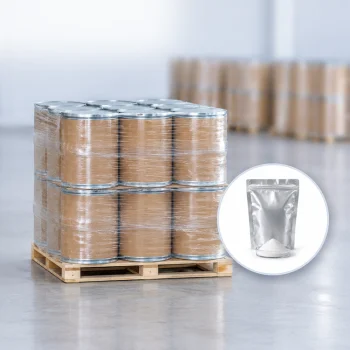
Packaging:Customizable
Description
Iron Sodium Diphosphate (CAS 10045-87-1) is an inorganic salt combining iron, sodium, and phosphate in a single solid-phase composition. It is supplied as a fine powder and is described as white in appearance. The compound belongs to the family of mixed-cation phosphate salts, in which iron and sodium cations are charge-balanced by phosphate anions within an extended ionic lattice. In inorganic salt and phosphate material systems, it serves as a solid iron- and phosphorus-bearing source for composition and formulation work.
In inorganic salt handling and dry-blend material preparation, Iron Sodium Diphosphate is used as a solid phosphate-based component during batch weighing, blending, and packaging operations. The resulting powder blends and salt compositions are handled in technical and industrial material contexts where a combined iron-sodium phosphate source is required.
Application
- Inorganic salt and phosphate material formulation: In inorganic salt and phosphate material formulation, Iron Sodium Diphosphate serves as a solid mixed-cation phosphate component, where its iron, sodium, and phosphate constituents contribute to the overall ionic composition of the blend. The resulting material is used in technical formulation work requiring a combined iron-sodium phosphate source.
- Dry powder blending and batch preparation: In dry powder blending, Iron Sodium Diphosphate serves as a fine particulate solid component, where its powder form supports uniform dispersion in dry mixes. The resulting blends are handled in industrial batch preparation and packaging operations.
- Iron and phosphorus source in material compositions: In material compositions requiring a combined iron and phosphorus input, Iron Sodium Diphosphate serves as a solid-phase source of both elements, where its salt structure provides iron and phosphate in a single component. The resulting compositions are used in technical material preparation.
- Inorganic salt reference and characterization work: In inorganic salt characterization work, Iron Sodium Diphosphate may be evaluated as a mixed-cation phosphate sample, where its ionic composition supports identification and composition studies. This is a laboratory characterization context.
Basic Information
| Property | Value |
|---|---|
| Product Name | Iron Sodium Diphosphate |
| CAS No. | 10045-87-1 |
| Molecular Formula | FeNaO7P2 |
| Molecular Weight | 291.79 g/mol |
| Physical | fine powder |
| Color | white |
| Chemical Property | H-bond donors 0; H-bond acceptors 7; TPSA 136; rotatable bonds 0; formal charge 0 |
| Customization | Content/concentration customizable per client specification |
Quality Control
The quality of Iron Sodium Diphosphate is governed by its composition as a mixed iron-sodium phosphate salt, which affects its behavior as a solid component in dry blends and technical material compositions.
| Differentiated QC focus | Structure, application impact, detection and control |
|---|---|
| Identity and composition | The product is a mixed-cation phosphate salt containing iron and sodium. In dry-blend and technical material preparation, an incorrect cation ratio or a different phosphate phase can shift the composition of the final blend. Confirm identity and composition against an agreed specification, and qualify incoming material before use. Test by elemental analysis for iron and sodium and by phosphate content determination. |
| Iron content | Iron is a defining constituent of the salt. In material compositions where the iron input matters, low or high iron content changes the delivered iron level. Set an agreed specification range for iron content and trend results across lots. Test by titrimetric or instrumental elemental methods. |
| Sodium content | Sodium is the second cation in the salt. Variation in sodium content indicates compositional drift that can affect the balance of the material. Set an agreed specification range and monitor against the iron result. Test by elemental methods such as flame photometry or ICP techniques. |
| Phosphate content | Phosphate is the principal anion. In phosphate-bearing compositions, phosphate content determines the delivered phosphorus level. Set an agreed specification range and check consistency across lots. Test by gravimetric or spectrophotometric phosphate determination. |
| Moisture content | A fine powder can pick up moisture during storage and handling. In dry blends, elevated moisture can cause caking, poor flow, and non-uniform dispersion. Set an agreed moisture limit, keep containers closed, and check moisture before blending. Test by loss on drying or Karl Fischer titration where appropriate. |
| Particle size and powder flow | The product is supplied as a fine powder. In dry blending, particle size and flow behavior affect dispersion uniformity and handling. Use an agreed particle-size range and monitor flow behavior for blends requiring uniform distribution. Test by sieving or particle-size analysis. |
| Appearance and color | The product is described as white. Off-color material can indicate contamination or a different phase. In applications where appearance matters, color variation affects the acceptability of the blend. Compare against an agreed color standard and inspect incoming lots. Test by visual comparison against a reference standard. |
| Insoluble matter and foreign particulates | Insoluble residue or foreign particulates can be introduced during handling and packaging. In fine powder blends, particulates can cause non-uniformity and visible defects. Include inspection and, where required, filtration or sieving checks. Test by gravimetric insoluble-matter determination. |
Batch release, COA and traceability. Each batch is released only when it conforms to the agreed specification. The Certificate of Analysis (COA) records the actual analytical methods and results for that released batch. Batch identity and results remain traceable, with lot trending used where it supports consistency review.
Storage
- Storage conditions: Store in a cool, dry, well-ventilated area. Keep containers tightly closed when not in use to limit moisture pickup.
- Secure storage: Store in a secure, designated area with access limited to authorized personnel.
- Incompatible materials: Keep away from strong oxidizing agents.
- Handling precautions: Avoid generating and breathing dust. Use only in a well-ventilated area. Wear protective gloves, protective clothing, eye protection, and face protection. Wash hands thoroughly after handling.
- Waste disposal: Dispose of contents and container in accordance with local, regional, national, and international regulations.
- Reference: Refer to the Safety Data Sheet (SDS) for detailed handling and disposal information.
Hot Related Products

Calcium Phosphate Dibasic Dihydrate CAS NO 7789-77-7
Magnesium Citrate CAS NO 7779-25-1
Magnesium Hydrogen Phosphate Trihydrate CAS NO 7782-75-4
Calcium Citrate Tetrahydrate CAS NO 5785-44-4
Zinc Citrate Dihydrate CAS NO 5990-32-9
Calcium Phosphate Tribasic CAS NO 12167-74-7
Sodium Ferrous Citrate CAS NO 43160-25-4
Calcium Citrate Malate CAS NO 142606-53-9
Trimagnesium Dicitrate CAS NO 3344-18-1
Calcium Phosphate CAS NO 7758-87-4

Lactate CAS NO 113-21-3
Monocalciumcitrate CAS NO 1185-56-4
Ferric Glycerophosphate CAS NO 1301-70-8
Calcium Glycerophosphate CAS NO 1336-00-1
Ferric Pyrophosphate CAS NO 1332-96-3

Ferric Ammonium Citrate,Brown CAS NO 1385-57-5
Ferrous Phosphate CAS NO 10028-23-6
Calcium Iodate CAS NO 10031-32-0
Iron(Iii)Pyrophosphate Nonahydarate CAS NO 10049-18-0
Ferric Pyrophosphate CAS NO 10058-44-3
why choose us
Trusted Manufacturer
With our own production facilities, we ensure consistent quality, reliable supply, and full traceability.
Rigorous Quality Assurance
Each batch undergoes strict QC, accompanied by COA, MSDS, and full compliance with international standards.
Advanced R&D Expertise
Our in-house lab drives process innovation, new product development, and tailored synthesis solutions.