




share
Monocalciumcitrate CAS NO 1185-56-4
Unit Price:
CAS No.:1185-56-4
Grade:Customizable
Content:Customizable
Brand:Customizable
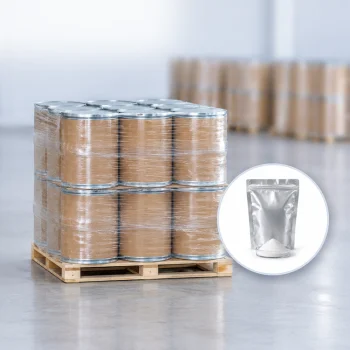
Packaging:Customizable
Description
Monocalciumcitrate (CAS 1185-56-4) is a calcium salt of citric acid, recorded in the supplied database as a fine white powder. It is a solid, water-dispersible mineral salt whose composition combines a calcium cation with citrate anions. Its citrate moiety provides a polycarboxylate structural unit that binds calcium and contributes to the salt's solubility and buffering behavior in aqueous systems. In food and nutrient fortification systems, it serves as a calcium source for mineral enrichment of formulated products.
In food and nutrient fortification, Monocalciumcitrate is incorporated as a calcium-bearing ingredient during batch formulation of powdered and liquid products. The resulting fortified formulations are used in food and nutritional product manufacturing for calcium content adjustment.
Application
- Calcium fortification of foods: In food formulation, Monocalciumcitrate serves as a calcium source, where its calcium content contributes to mineral enrichment of the finished product. The resulting fortified foods are used in general food manufacturing for calcium content adjustment.
- Nutrient fortification systems: In nutrient fortification, Monocalciumcitrate serves as a mineral ingredient, where its citrate-bound calcium contributes to the mineral profile of the formulation. The resulting fortified preparations are used in nutritional product manufacturing.
- Powdered food and beverage premixes: In powdered premix formulation, Monocalciumcitrate serves as a dispersible calcium ingredient, where its fine powder form supports blending into dry mixes. The resulting premixes are used in food and beverage preparation for calcium content adjustment.
- Calcium source in formulated products: In formulated product development, Monocalciumcitrate may be evaluated as a calcium source, where its citrate salt structure supports mineral incorporation studies. This is a formulation research context.
Basic Information
| Property | Value |
|---|---|
| Product Name | Monocalciumcitrate |
| CAS No. | 1185-56-4 |
| Molecular Formula | C6H6CaO7 |
| Molecular Weight | 214.15 g/mol |
| Physical | Fine powder |
| Color | White |
| Chemical Property | H-bond donors 2; H-bond acceptors 7; TPSA 138; rotatable bonds 3; formal charge 0 |
| Customization | Content/concentration customizable per client specification |
Quality Control
The quality of Monocalciumcitrate is governed by its identity as a calcium citrate salt and by the physical characteristics of the supplied powder, which affect its behavior in food and nutrient fortification formulations.
| Differentiated QC focus | Structure, application impact, detection and control |
|---|---|
| Identity and calcium content | The product is a calcium salt of citric acid, and its calcium content determines its value as a mineral source in fortified foods. Insufficient or excess calcium relative to the agreed specification can shift the mineral contribution of the finished formulation. Identity should be confirmed against the agreed specification, with calcium content checked by complexometric titration or equivalent methods and citrate confirmed by suitable chromatographic or spectroscopic techniques. |
| Moisture content | Residual moisture affects powder flow, dispersibility and storage behavior of the solid salt. Elevated moisture can cause caking and uneven blending in dry premix formulation. Moisture should be monitored against an agreed limit, with packaging and storage conditions controlled to limit uptake. Test by loss-on-drying or Karl Fischer titration where appropriate. |
| Particle size and powder characteristics | The product is supplied as a fine powder, and particle size distribution affects blending uniformity and dispersion in dry mixes. Coarse or agglomerated material can cause segregation or incomplete dispersion. Particle size and bulk behavior should be checked against agreed ranges, with sieving or laser diffraction used for characterization. |
| Appearance and color | The product is described as white, and color deviation can indicate contamination or degradation. Off-color material may affect the appearance of light-colored finished products. Color should be compared against an agreed standard, with raw material qualification and storage protection from light and heat. |
| Foreign matter and insoluble residue | Particulate contamination can arise from handling, packaging or processing equipment. Insoluble matter can affect clarity and appearance in liquid formulations. Filtration or gravimetric residue checks should be applied where the application requires, with clean handling and packaging controls. |
Batch release, COA and traceability. Each batch is released only when it conforms to the agreed specification. The Certificate of Analysis (COA) records the actual analytical methods and results for that released batch. Batch identity and results remain traceable, with lot trending used where it supports consistency review.
Storage
- Storage conditions: Store in a cool, dry, well-ventilated area. Keep containers tightly closed when not in use.
- Secure storage: Store in a secure, designated area with access limited to authorized personnel.
- Incompatible materials: Keep away from strong oxidizers.
- Handling precautions: Avoid breathing dust. Use only in a well-ventilated area. Wear protective gloves, protective clothing, eye protection, and face protection. Wash hands thoroughly after handling.
- Waste disposal: Dispose of contents and container in accordance with local, regional, national, and international regulations.
- Reference: Refer to the Safety Data Sheet (SDS) for detailed handling and disposal information.
Hot Related Products

Calcium Phosphate Dibasic Dihydrate CAS NO 7789-77-7
Magnesium Citrate CAS NO 7779-25-1
Magnesium Hydrogen Phosphate Trihydrate CAS NO 7782-75-4
Calcium Citrate Tetrahydrate CAS NO 5785-44-4
Zinc Citrate Dihydrate CAS NO 5990-32-9
Calcium Phosphate Tribasic CAS NO 12167-74-7
Sodium Ferrous Citrate CAS NO 43160-25-4
Calcium Citrate Malate CAS NO 142606-53-9
Trimagnesium Dicitrate CAS NO 3344-18-1
Calcium Phosphate CAS NO 7758-87-4

Lactate CAS NO 113-21-3
Ferric Glycerophosphate CAS NO 1301-70-8
Calcium Glycerophosphate CAS NO 1336-00-1
Ferric Pyrophosphate CAS NO 1332-96-3

Ferric Ammonium Citrate,Brown CAS NO 1385-57-5
Calcium Iodate CAS NO 10031-32-0
Ferrous Phosphate CAS NO 10028-23-6
Iron Sodium Diphosphate CAS NO 10045-87-1
Iron(Iii)Pyrophosphate Nonahydarate CAS NO 10049-18-0
Ferric Pyrophosphate CAS NO 10058-44-3
why choose us
Trusted Manufacturer
With our own production facilities, we ensure consistent quality, reliable supply, and full traceability.
Rigorous Quality Assurance
Each batch undergoes strict QC, accompanied by COA, MSDS, and full compliance with international standards.
Advanced R&D Expertise
Our in-house lab drives process innovation, new product development, and tailored synthesis solutions.