




share
Octenylsuccinic Acid CAS NO 28805-58-5
Unit Price:
CAS No.:28805-58-5
Grade:Customizable
Content:Customizable
Brand:Customizable
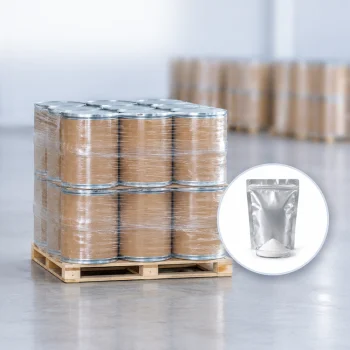
Packaging:Customizable
Description
Octenylsuccinic Acid (CAS 28805-58-5) is an alkenyl-substituted succinic acid, a dicarboxylic acid carrying a C8 alkenyl chain on the succinic backbone. It is supplied as a fine, off-white powder. As a dibasic acid bearing a hydrophobic alkenyl side chain, it combines an ionizable dicarboxyl head with a lipophilic tail, which gives the molecule amphiphilic character at oil-water interfaces. In industrial formulation and material modification, it serves as a bifunctional acid building block for esterification, salt formation, and surface functionalization.
In starch and polysaccharide modification, Octenylsuccinic Acid serves as the esterifying acid that introduces alkenylsuccinate groups onto hydroxyl-bearing polymer chains during batch reaction and repeated manufacturing. The resulting modified polysaccharide is used in food and industrial formulation for emulsification and emulsion stabilization.
Application
- Starch and polysaccharide esterification: In modified-starch production, Octenylsuccinic Acid serves as the esterifying reagent, where its succinic anhydride-forming dicarboxyl function reacts with hydroxyl groups of starch or other polysaccharides to introduce alkenylsuccinate substituents. The resulting modified polysaccharide is used in food and industrial formulations for emulsification and emulsion stability.
- Emulsifier and emulsion stabilization: In oil-in-water emulsion systems, Octenylsuccinic Acid and its salts serve as amphiphilic emulsifier components, where the alkenyl chain provides lipophilic anchoring and the dicarboxyl head provides hydrophilic character. The resulting emulsions are used in food, cosmetic, and industrial formulation contexts.
- Surface and interface modification: In surface treatment formulation, Octenylsuccinic Acid serves as a carboxyl-functional modifier, where its dicarboxyl groups can anchor to mineral or oxide surfaces while the alkenyl chain adjusts surface energy. The resulting treated surfaces are used in dispersion and wetting applications.
- Ester and salt derivative preparation: In derivative preparation, Octenylsuccinic Acid serves as a dicarboxylic acid building block, where its two carboxyl groups support mono- and di-ester formation and salt formation with bases or amines. The resulting esters and salts are used as emulsifiers, dispersants, and functional additives.
- Dispersant and wetting formulation: In pigment and particulate dispersion, Octenylsuccinic Acid salts serve as anionic dispersing components, where carboxylate charge contributes to particle stabilization and the alkenyl chain contributes to compatibility with nonpolar media. The resulting dispersions are used in coating and industrial formulation.
- Industrial formulation research: In formulation research, Octenylsuccinic Acid may be evaluated as an amphiphilic dicarboxylic acid for interface and emulsification studies, where its combined carboxyl and alkenyl functionality supports systematic comparison of surface activity.
Basic Information
| Property | Value |
|---|---|
| Product Name | Octenylsuccinic Acid |
| CAS No. | 28805-58-5 |
| Molecular Formula | UNKNOWN |
| Molecular Weight | 228.29 g/mol |
| Physical | fine powder |
| Color | off-white |
| Chemical Property | UNKNOWN |
| Customization | Content/concentration customizable per client specification |
Quality Control
The quality of Octenylsuccinic Acid is governed by its dicarboxylic acid functionality and its alkenyl chain, which together determine acid value, esterification behavior, and interfacial performance in emulsification and polysaccharide modification.
| Differentiated QC focus | Structure, application impact, detection and control |
|---|---|
| Acid value and carboxyl content | The two carboxyl groups on the succinic backbone drive esterification and salt formation. In starch esterification and emulsifier preparation, low acid value indicates incomplete carboxyl functionality and can reduce substitution efficiency, while an elevated value may indicate residual free acid or hydrolysis products. Set an agreed acid value range, qualify incoming lots, and trend acid value against reaction or emulsification response. Test by titration with standardized base. |
| Alkenyl chain identity and distribution | The C8 alkenyl substituent provides the lipophilic character required for interfacial activity. In emulsifier and surface modification use, chain length or isomer distribution affects hydrophile-lipophile balance and emulsion stability. Set agreed limits on alkenyl content and distribution, and compare lots against a reference profile. Test by gas or liquid chromatography after derivatization where suitable. |
| Moisture and hygroscopicity | The supplied description indicates a tendency to absorb moisture. In esterification and salt preparation, absorbed water can shift acid value, promote hydrolysis, and cause caking or dosing variation. Use moisture-controlled packaging and storage, set a water content limit, and check lots before moisture-sensitive reactions. Test by Karl Fischer titration or loss on drying. |
| Appearance and particulate characteristics | The product is described as a fine off-white powder. Color development or coarse agglomeration can indicate oxidation, moisture uptake, or inconsistent particle formation, which affects dispersion and feeding behavior. Set agreed color and particle-size limits, protect from moisture and heat, and inspect lots before use. Test by visual comparison and particle-size analysis. |
| Insoluble matter and foreign particulates | Insoluble residues or foreign particulates can arise from raw materials or handling. In emulsifier and dispersion applications, particulates can cause specks, filter blockage, or unstable dispersions. Include filtration or screening during production and set an agreed limit on insoluble matter. Test by gravimetric filtration. |
Batch release, COA and traceability. Each batch is released only when it conforms to the agreed specification. The Certificate of Analysis (COA) records the actual analytical methods and results for that released batch. Batch identity and results remain traceable, with lot trending used where it supports consistency review.
Storage
- Storage conditions: Store in a cool, dry, well-ventilated area. Keep containers tightly closed when not in use to limit moisture uptake.
- Secure storage: Store in a secure, designated area with access limited to authorized personnel.
- Incompatible materials: Keep away from strong oxidizing agents and strong bases.
- Handling precautions: Avoid breathing dust. Use only in a well-ventilated area. Wear protective gloves, protective clothing, eye protection, and face protection. Wash hands thoroughly after handling.
- Waste disposal: Dispose of contents and container in accordance with local, regional, national, and international regulations.
- Reference: Refer to the Safety Data Sheet (SDS) for detailed handling and disposal information.
Hot Related Products

Lecithin CAS NO 8002-43-5

Glycerides, C8-10 CAS NO 85409-09-2

Starch Sodiilm Octenylsuccinate CAS NO 66829-29-6

Sucrose Palmitate CAS NO 26446-38-8
Sucrose Monolaurate CAS NO 25339-99-5

Monocaprylin CAS NO 26402-26-6
n-Hydroxy Succinate CAS NO 8005-40-1
Sucrose Benzoate CAS NO 12738-64-6

Glycery Monolaurate CAS NO 142-18-7
Monobehenin CAS NO 30233-64-8
Lecithin Hydrogenated CAS NO 92128-87-5

Glyceryl Monooleate CAS NO 111-03-5
Ethylene Glycol Monostearate CAS NO 111-60-4

Sucrose Acetate Isobutyrate CAS NO 126-13-6
Monostearin CAS NO 123-94-4
Propylene Glycol Monostearate (Contains Ca. 35% Monopalmitate) CAS NO 1323-39-3
D-Glucitol Monooleate CAS NO 1333-68-2
D-Glucitol Trioleate CAS NO 1333-71-7
2-(Hexadecanoyloxy)Propionic Acid, Monoester With Glycerol CAS NO 1335-49-5
Stearyl Citrate CAS NO 1337-33-3
why choose us
Trusted Manufacturer
With our own production facilities, we ensure consistent quality, reliable supply, and full traceability.
Rigorous Quality Assurance
Each batch undergoes strict QC, accompanied by COA, MSDS, and full compliance with international standards.
Advanced R&D Expertise
Our in-house lab drives process innovation, new product development, and tailored synthesis solutions.