




share
Glycerol Palmitate CAS NO 26657-96-5
Unit Price:
CAS No.:26657-96-5
Grade:Customizable
Content:Customizable
Brand:Customizable
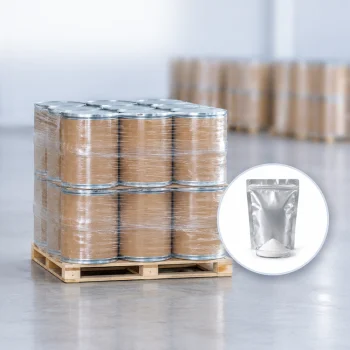
Packaging:Customizable
Description
Glycerol Palmitate (CAS 26657-96-5) is a glycerol ester of palmitic acid, a fatty acid monoester in which a palmitoyl chain is attached to a glycerol backbone. It is described in the supplied records as a fine white powder. As a partial glyceride, it combines a lipophilic fatty acid chain with residual hydroxyl groups on the glycerol unit, a structural arrangement that supports surface activity and emulsification behavior. In food additive and emulsifier contexts, Glycerol Palmitate serves as a surface-active ester for oil-in-water emulsification and emulsion stabilization in lipid-containing systems.
In emulsifier and lipid-based formulation work, Glycerol Palmitate serves as a surface-active partial glyceride during batch compounding and repeated manufacturing of emulsions and fat-containing preparations. The resulting emulsified materials are used in food and general formulation applications for combining oil and water phases and maintaining emulsion consistency.
Application
- Food emulsification: In food formulation, Glycerol Palmitate serves as an emulsifier, where its palmitoyl chain and glycerol hydroxyl groups contribute to oil-in-water emulsification. The resulting emulsified food preparations are used for combining fat and aqueous phases and maintaining product consistency.
- Emulsion stabilization: In emulsion-based formulations, Glycerol Palmitate serves as a surface-active component, where its partial glyceride structure contributes to interfacial film formation. The resulting emulsions are used in food and general formulation systems for phase stability.
- Lipid-based formulation: In lipid-containing formulation work, Glycerol Palmitate serves as a fatty acid monoester component, where its lipophilic palmitoyl chain contributes to oil-phase compatibility. The resulting formulations are used in food and material systems requiring fat-phase incorporation.
- Fat and oil processing: In fat and oil processing, Glycerol Palmitate serves as a partial glyceride component, where its monoester structure contributes to blending with triglyceride oils. The resulting blends are used in food ingredient preparation for texture and phase adjustment.
- Surface-active ester formulation research: In surface-active ester formulation research, Glycerol Palmitate may be evaluated as a model glycerol monoester, where its palmitoyl chain and hydroxyl groups support interfacial studies. This is a research evaluation context.
Basic Information
| Property | Value |
|---|---|
| Product Name | Glycerol Palmitate |
| CAS No. | 26657-96-5 |
| Molecular Formula | UNKNOWN |
| Molecular Weight | 330.51 g/mol |
| Physical | fine powder |
| Color | white |
| Chemical Property | UNKNOWN |
| Customization | Content/concentration customizable per client specification |
Quality Control
The quality of Glycerol Palmitate is governed by its identity as a glycerol ester of palmitic acid and by the balance between its lipophilic palmitoyl chain and the residual hydroxyl groups of the glycerol unit, which together determine its emulsification behavior.
| Differentiated QC focus | Structure, application impact, detection and control |
|---|---|
| Ester identity and composition | The product is a glycerol ester of palmitic acid; the identity of the fatty acid moiety and the degree of esterification determine surface activity and emulsifying function. In food emulsification and emulsion stabilization, an off-specification ester profile can shift emulsifying performance and emulsion stability. Confirm identity against an agreed specification and qualify incoming material against that specification. |
| Monoester content | The proportion of monoester relative to higher glycerides affects surface activity and emulsifying capacity. In oil-in-water emulsification, a low monoester fraction can reduce emulsifying effectiveness, while a high fraction can alter texture and phase behavior. Set an agreed specification range for monoester content and trend it against emulsification performance. |
| Free fatty acid | Residual free palmitic acid can arise from incomplete esterification or hydrolysis. In food and lipid-based formulations, elevated free fatty acid can affect taste, oxidative stability and emulsion behavior. Set specification limits on free fatty acid and control it through the agreed manufacturing specification. |
| Moisture | Water content affects powder flow, storage stability and the risk of hydrolysis of the ester. In powder handling and lipid-based formulation, elevated moisture can cause caking and accelerate ester hydrolysis. Set specification limits on water content and protect the material from moisture during storage. |
| Appearance and color | The product is described as a fine white powder; color or appearance deviation can indicate oxidation, contamination or thermal degradation. In food applications, appearance affects product quality. Set agreed appearance limits and protect the material from light and heat. |
Batch release, COA and traceability. Each batch is released only when it conforms to the agreed specification. The Certificate of Analysis (COA) records the actual analytical methods and results for that released batch. Batch identity and results remain traceable, with lot trending used where it supports consistency review.
Storage
- Storage conditions: Store in a cool, dry, well-ventilated area. Keep containers tightly closed when not in use.
- Secure storage: Store in a secure, designated area with access limited to authorized personnel.
- Incompatible materials: Keep away from strong oxidizers.
- Handling precautions: Avoid breathing dust. Use only in a well-ventilated area. Wear protective gloves, protective clothing, eye protection, and face protection. Wash hands thoroughly after handling.
- Waste disposal: Dispose of contents and container in accordance with local, regional, national, and international regulations.
- Reference: Refer to the Safety Data Sheet (SDS) for detailed handling and disposal information.
Hot Related Products

Lecithin CAS NO 8002-43-5

Glycerides, C8-10 CAS NO 85409-09-2

Starch Sodiilm Octenylsuccinate CAS NO 66829-29-6

Sucrose Palmitate CAS NO 26446-38-8
Sucrose Monolaurate CAS NO 25339-99-5

Monocaprylin CAS NO 26402-26-6
n-Hydroxy Succinate CAS NO 8005-40-1
Sucrose Benzoate CAS NO 12738-64-6

Glycery Monolaurate CAS NO 142-18-7
Monobehenin CAS NO 30233-64-8
Lecithin Hydrogenated CAS NO 92128-87-5

Glyceryl Monooleate CAS NO 111-03-5
Ethylene Glycol Monostearate CAS NO 111-60-4

Sucrose Acetate Isobutyrate CAS NO 126-13-6
Monostearin CAS NO 123-94-4
Propylene Glycol Monostearate (Contains Ca. 35% Monopalmitate) CAS NO 1323-39-3
D-Glucitol Monooleate CAS NO 1333-68-2
D-Glucitol Trioleate CAS NO 1333-71-7
2-(Hexadecanoyloxy)Propionic Acid, Monoester With Glycerol CAS NO 1335-49-5
Stearyl Citrate CAS NO 1337-33-3
why choose us
Trusted Manufacturer
With our own production facilities, we ensure consistent quality, reliable supply, and full traceability.
Rigorous Quality Assurance
Each batch undergoes strict QC, accompanied by COA, MSDS, and full compliance with international standards.
Advanced R&D Expertise
Our in-house lab drives process innovation, new product development, and tailored synthesis solutions.