




share
Dipotassium Disodium Diphosphate CAS NO 15491-89-1
Unit Price:
CAS No.:15491-89-1
Grade:Customizable
Content:Customizable
Brand:Customizable
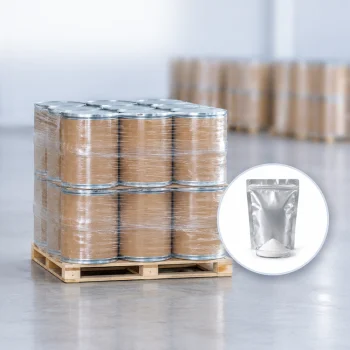
Packaging:Customizable
Description
Dipotassium Disodium Diphosphate (CAS 15491-89-1) is a mixed potassium-sodium condensed phosphate salt. It is supplied as white crystalline granules. As a fully neutralized alkali-metal diphosphate, it is a water-soluble ionic salt whose behavior in aqueous systems is governed by phosphate anion equilibria, ionic strength, and pH. In aqueous formulation systems, it serves as a soluble phosphate source and electrolyte for buffering, sequestering, and dispersion functions. Its mixed potassium and sodium counter-ion composition distinguishes it from the single-cation diphosphates in solubility and solution ionic profile.
In aqueous formulation and processing systems, Dipotassium Disodium Diphosphate is used as a soluble condensed-phosphate component during batch preparation and blending. The resulting formulations are used in industrial processing, food-additive preparation, and dispersion applications where phosphate buffering, sequestration, and ionic adjustment functions are required.
Application
- Emulsifier and dispersion formulation: In emulsifier and dispersion formulation, Dipotassium Disodium Diphosphate serves as a soluble phosphate electrolyte, where its condensed phosphate anion contributes to ionic adjustment and dispersion stability. The resulting formulations are used in industrial and food-additive processing for emulsion and dispersion control.
- Buffering and pH adjustment: In aqueous buffering systems, Dipotassium Disodium Diphosphate serves as a phosphate buffer component, where its diphosphate anion contributes to pH stabilization across the working range of the formulation. The resulting buffer systems are used in industrial processing and analytical preparation.
- Sequestration of metal ions: In sequestration formulations, Dipotassium Disodium Diphosphate serves as a phosphate-based sequestrant, where its condensed phosphate anion contributes to binding of polyvalent metal ions. The resulting formulations are used in industrial water processing and processing to limit metal-induced interference.
- Food additive formulation: In food additive formulation, Dipotassium Disodium Diphosphate serves as a phosphate salt component, where its solubility and phosphate anion contribute to buffering, sequestration, and texture-related functions in formulated products.
- Industrial cleaning and processing formulations: In industrial cleaning and processing formulations, Dipotassium Disodium Diphosphate serves as a soluble phosphate builder, where its anion contributes to water conditioning and soil dispersion. The resulting formulations are used in industrial cleaning and surface processing processes.
Basic Information
| Property | Value |
|---|---|
| Product Name | Dipotassium Disodium Diphosphate |
| CAS No. | 15491-89-1 |
| Molecular Formula | UNKNOWN |
| Molecular Weight | 324.08 g/mol |
| Physical | Crystalline granules |
| Color | White |
| Chemical Property | UNKNOWN |
| Customization | Content/concentration customizable per client specification |
Quality Control
The quality of Dipotassium Disodium Diphosphate is governed by its identity as a mixed potassium-sodium condensed phosphate and by the ionic and solubility behavior that controls its performance in buffering, sequestration, and dispersion applications. Because no product-specific quality focus items were supplied, the following points are general guidance to be defined after identity and specification confirmation.
| Differentiated QC focus | Structure, application impact, detection and control |
|---|---|
| Identity and phosphate speciation | The product is a mixed-cation diphosphate; confirming the diphosphate anion and the potassium-to-sodium ratio distinguishes it from other condensed phosphates. Misidentification can shift buffering capacity and sequestration behavior in formulation. Identity is typically examined by ion chromatography, phosphate speciation methods, or spectroscopic techniques after the specification is agreed. |
| Water content and hygroscopicity | Condensed phosphate salts can take up moisture during storage and handling, which affects weighing accuracy, flow, and solution concentration. Moisture should be monitored against an agreed limit, with packaging and storage controls matched to the confirmed product behavior. Karl Fischer titration or loss-on-drying may be applied once the specification is established. |
| pH of aqueous solution | The pH of a prepared solution reflects the acid-base state of the phosphate and directly affects buffering and dispersion performance. Solution pH should be measured on a defined concentration basis against an agreed range. |
| Water-insoluble matter and clarity | Insoluble residue or haze can interfere with dispersion and appearance in formulated products. Insoluble matter should be controlled against an agreed limit, with filtration or gravimetric methods applied as appropriate. |
| Trace metal ions | Residual polyvalent metal ions can consume sequestration capacity and affect formulation stability. Where the application requires it, trace metals should be controlled against agreed limits using suitable elemental analysis. |
Batch release, COA and traceability. Each batch is released only when it conforms to the agreed specification. The Certificate of Analysis (COA) records the actual analytical methods and results for that released batch. Batch identity and results remain traceable, with lot trending used where it supports consistency review.
Storage
- Storage conditions: Store in a cool, dry, well-ventilated area. Keep containers tightly closed when not in use.
- Secure storage: Store in a secure, designated area with access limited to authorized personnel.
- Incompatible materials: Keep away from strong oxidizing agents.
- Handling precautions: Avoid breathing dust. Use only in a well-ventilated area. Wear protective gloves, protective clothing, eye protection, and face protection. Wash hands thoroughly after handling.
- Waste disposal: Dispose of contents and container in accordance with local, regional, national, and international regulations.
- Reference: Refer to the Safety Data Sheet (SDS) for detailed handling and disposal information.
Hot Related Products

Lecithin CAS NO 8002-43-5

Glycerides, C8-10 CAS NO 85409-09-2

Starch Sodiilm Octenylsuccinate CAS NO 66829-29-6

Sucrose Palmitate CAS NO 26446-38-8
Sucrose Monolaurate CAS NO 25339-99-5

Monocaprylin CAS NO 26402-26-6
n-Hydroxy Succinate CAS NO 8005-40-1
Sucrose Benzoate CAS NO 12738-64-6

Glycery Monolaurate CAS NO 142-18-7
Monobehenin CAS NO 30233-64-8
Lecithin Hydrogenated CAS NO 92128-87-5

Glyceryl Monooleate CAS NO 111-03-5
Ethylene Glycol Monostearate CAS NO 111-60-4

Sucrose Acetate Isobutyrate CAS NO 126-13-6
Monostearin CAS NO 123-94-4
Propylene Glycol Monostearate (Contains Ca. 35% Monopalmitate) CAS NO 1323-39-3
D-Glucitol Monooleate CAS NO 1333-68-2
D-Glucitol Trioleate CAS NO 1333-71-7
2-(Hexadecanoyloxy)Propionic Acid, Monoester With Glycerol CAS NO 1335-49-5
Stearyl Citrate CAS NO 1337-33-3
why choose us
Trusted Manufacturer
With our own production facilities, we ensure consistent quality, reliable supply, and full traceability.
Rigorous Quality Assurance
Each batch undergoes strict QC, accompanied by COA, MSDS, and full compliance with international standards.
Advanced R&D Expertise
Our in-house lab drives process innovation, new product development, and tailored synthesis solutions.