




share
Dodecyltriphenylphosphonium Bromide CAS NO 15510-55-1
Unit Price:
CAS No.:15510-55-1
Grade:Customizable
Content:Customizable
Brand:Customizable
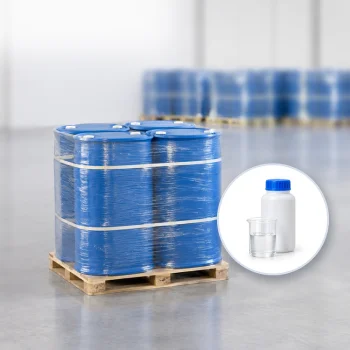
Packaging:Customizable
Description
Dodecyltriphenylphosphonium Bromide (CAS 15510-55-1) is a quaternary phosphonium salt composed of a dodecyltriphenylphosphonium cation paired with a bromide counterion. It is recorded as a white solid. The cation combines a long C12 alkyl chain with three phenyl substituents on a positively charged phosphorus center, a structural arrangement that gives the salt pronounced lipophilicity alongside a persistent cationic charge. In phase-transfer catalysis and cationic surface-processing systems, it serves as a lipophilic cation source for transferring ionic species into organic media and for imparting positive surface charge.
In organic synthesis and two-phase reaction processing, Dodecyltriphenylphosphonium Bromide serves as a phase-transfer catalyst during batch and repeated manufacturing operations, where its lipophilic phosphonium cation carries anionic reactants into the organic phase. The resulting reaction mixtures are used in fine chemical and specialty organic production for improved conversion and simplified phase separation.
Application
- Phase-transfer catalysis: In two-phase organic reactions, Dodecyltriphenylphosphonium Bromide serves as a phase-transfer catalyst, where its lipophilic dodecyltriphenylphosphonium cation pairs with anionic species and transports them into the organic phase. The resulting reaction systems are used in fine chemical and specialty organic manufacturing for substitution, alkylation, and oxidation conversions.
- Cationic surfactant formulation: In surface-processing and formulation systems, Dodecyltriphenylphosphonium Bromide serves as a cationic surfactant component, where its long alkyl chain and quaternary phosphonium head group contribute to adsorption at interfaces and to positive surface charge. The resulting formulations are used in industrial surface conditioning and dispersion control.
- Antistatic processing: In polymer and surface antistatic processing, Dodecyltriphenylphosphonium Bromide serves as a cationic charge-control additive, where its lipophilic cation contributes to surface conductivity and static dissipation. The resulting processed materials are used in industrial polymer and coating applications where static buildup is a concern.
- Organic synthesis reagent: In organic synthesis, Dodecyltriphenylphosphonium Bromide serves as a phosphonium salt reagent, where its quaternary phosphorus center and bromide counterion participate in salt metathesis and phosphorus ylide preparation. The resulting products are used in specialty organic chemical manufacturing.
- Electrolyte and electrochemical formulation: In electrochemical formulation work, Dodecyltriphenylphosphonium Bromide may be evaluated as a quaternary phosphonium electrolyte component, where its lipophilic cation and bromide anion contribute to ionic conductivity in non-aqueous media. This is a formulation research context.
- Biocidal and antimicrobial formulation research: In antimicrobial formulation research, Dodecyltriphenylphosphonium Bromide may be evaluated as a quaternary phosphonium active, where its lipophilic cation supports studies of membrane interaction. This is a research evaluation context.
Basic Information
| Property | Value |
|---|---|
| Product Name | Dodecyltriphenylphosphonium Bromide |
| CAS No. | 15510-55-1 |
| Molecular Formula | UNKNOWN |
| Molecular Weight | 511.51 g/mol |
| Physical | Solid |
| Color | White |
| Chemical Property | UNKNOWN |
| Customization | Content/concentration customizable per client specification |
Quality Control
The quality of Dodecyltriphenylphosphonium Bromide is governed by its quaternary phosphonium structure, in which a dodecyltriphenylphosphonium cation is paired with a bromide counterion. Identity, counterion balance, and purity of the lipophilic cation directly affect phase-transfer activity, surface activity, and behavior in formulated systems.
| Differentiated QC focus | Structure, application impact, detection and control |
|---|---|
| Identity and counterion confirmation | The product is a quaternary phosphonium bromide, and its function depends on the specific dodecyltriphenylphosphonium cation together with the bromide counterion. In phase-transfer and surface-processing uses, a mismatched cation or counterion changes lipophilicity and ion-transfer behavior. Confirm structure by spectroscopic means and confirm the bromide counterion by ion analysis, with identity checks applied to each lot. |
| Assay and phosphonium content | The active content of the quaternary phosphonium salt determines how much cationic species is available for ion transfer or surface adsorption. In phase-transfer catalysis, low assay requires higher loading and can shift reaction performance. Establish an agreed assay specification and determine content by titration or chromatographic methods suited to quaternary salts. |
| Moisture and hygroscopicity | The salt is recorded as hygroscopic in source descriptions, so absorbed water can dilute the active content and affect handling and weighing. In moisture-sensitive reactions and formulations, water can interfere with ionic transfer and with non-aqueous systems. Control moisture through closed packaging and defined drying, and monitor water content by Karl Fischer titration. |
| Inorganic halide and residual salts | Residual bromide or inorganic salts from preparation can remain in the product and affect ionic strength and phase behavior. In catalysis and electrolyte uses, excess halide can alter selectivity and conductivity. Set limits on inorganic halide and monitor by ion chromatography or titration. |
| Volatile matter and residual solvents | Residual solvents or volatiles from isolation can affect purity and handling behavior. In catalysis and formulation, volatiles can change concentration and introduce inconsistent performance. Define drying conditions and set a volatile-matter limit, checked by oven volatilization or headspace GC. |
| Appearance and particulate content | The product is recorded as a white solid, and color or particulate contamination can indicate impurities or handling issues. In surface-processing and formulation uses, particulates can cause uneven dispersion. Apply agreed color standards and filtration or sieving checks where the application requires. |
Batch release, COA and traceability. Each batch is released only when it conforms to the agreed specification. The Certificate of Analysis (COA) records the actual analytical methods and results for that released batch. Batch identity and results remain traceable, with lot trending used where it supports consistency review.
Storage
- Storage conditions: Store in a cool, dry, well-ventilated area. Keep containers tightly closed when not in use to limit moisture pickup.
- Secure storage: Store in a secure, designated area with access limited to authorized personnel.
- Incompatible materials: Keep away from strong oxidizers.
- Handling precautions: Avoid breathing dust. Use only in a well-ventilated area. Wear protective gloves, protective clothing, eye protection, and face protection. Wash hands thoroughly after handling.
- Waste disposal: Dispose of contents and container in accordance with local, regional, national, and international regulations.
- Reference: Refer to the Safety Data Sheet (SDS) for detailed handling and disposal information.
Hot Related Products

(Z,Z)-2-(8-Heptadecenyl)-4,5-Dihydro-1-Methyl-3-[2-[(1-Oxo-9-Octadecenyl)Amino]Ethyl]-1H-Imidazolium Methyl Sulphate CAS NO 94944-77-1

Tributyltetradecylphosphonium Chloride CAS NO 81741-28-8

Quaternary Ammonium Compounds, C12-18-Alkyl(Hydroxyethyl)Dimethyl, Chlorides CAS NO 85736-63-6
Diallyldimethylammonium Chloride CAS NO 7398-69-8
Benzyldimethylphenylammonium Chloride CAS NO 3204-68-0
Ethonium CAS NO 21954-74-5
Dodecyldimethylbenzylammonium Chloride CAS NO 139-07-1
Dioctadecyl Dimethyl Ammonium Chloride CAS NO 107-64-2
1-(Dimethylamino)Tetradecane CAS NO 112-75-4
Methacrylatoethyl Trimethyl Ammonium Chloride CAS NO 5039-78-1
Dodecyltrimethylammonium Bromide CAS NO 1119-94-4
Cetyldimethylethylammonium Bromide CAS NO 124-03-8
Benzyldimethylhexadecylammonium Chloride CAS NO 122-18-9
Octadecy Trimethyl Ammonium Bromide CAS NO 1120-02-1
Tetradecyltrimethylammonium Bromide CAS NO 1119-97-7
Tetrahexylammonium Hydrogensulphate CAS NO 32503-34-7
Tetrapropylammonium Hydroxide CAS NO 4499-86-9
Hexadecyl Trimethyl Ammonium Bromide CAS NO 57-09-0
Methyl Tributyl Ammonium Chloride CAS NO 56375-79-2
Benzyltriethylammonium Chloride CAS NO 56-37-1
why choose us
Trusted Manufacturer
With our own production facilities, we ensure consistent quality, reliable supply, and full traceability.
Rigorous Quality Assurance
Each batch undergoes strict QC, accompanied by COA, MSDS, and full compliance with international standards.
Advanced R&D Expertise
Our in-house lab drives process innovation, new product development, and tailored synthesis solutions.