
Alumina-Filled Silicone Potting: Diagnosing Excessive Viscosity
 October 30, 2026
 Elena Duan
To diagnose excessive viscosity in alumina-filled thermal potting compounds, first confirm that loading and measurement conditions are comparable. Then test particle grading and surface treatment as separate variables. A coarse/fine blend may improve packing while increasing the surface that the liquid must wet, so broader grading does not guarantee lower viscosity. If only a combined grading-and-treatment change meets the flow requirement, that establishes a useful combination under the tested conditions; it does not by itself prove an interaction. This article addresses uncured, highly filled, two-component addition-cure silicone potting compounds.
Locate the First Loss of Flow
Identify the operation that fails: powder incorporation, pumping, passage through the static mixer, cavity filling or bubble release. A compound that dispenses under pressure may still stop flowing around components after dispensing.
Compare a satisfactory batch with the affected batch at the same processing stage. Record whether the sample is a stored filled component or the combined resin-and-curative mixture, together with actual sample temperature, elapsed time, mixing sequence and vacuum history.
Examine the filled components before combination as well as the mixed compound through its required working period. An abnormality already present before combination does not require mixed-system cure to explain its onset, although reactions within an individual component remain possible.
Where feasible, compare the corresponding unfilled binder. A change that also appears without alumina makes binder behavior or the cure package a priority for investigation.
Establish a Comparable Rheology Measurement
Report apparent viscosity with temperature, shear rate or the complete spindle-and-speed method, geometry, gap and sample conditioning. A single viscosity value without these conditions cannot establish equivalent flow behavior.
Compare a flow curve covering low-shear behavior and the range relevant to dispensing. Specify preshear and rest periods. For a reacting mixture, control sample age and measurement duration so that cure during testing does not masquerade as shear dependence.
The measurement gap must accommodate the largest particles or agglomerates present. D90 is not a maximum particle size. Check for wall slip if results change with gap or surface texture: slip can make concentrated suspensions appear less viscous. TA Instruments describes gap comparisons and roughened geometries as useful diagnostic checks.
Use the resulting method consistently for screening, then confirm its relevance through the actual dispensing and filling operation.
Reconstruct the Filler Loading
Check weighed additions before changing the powder blend. State whether the filler percentage describes one component, the combined compound, dry alumina or the supplied treated powder.
For a formulation containing alumina as its only particulate filler, calculate its nominal volume fraction from constituent masses and densities:
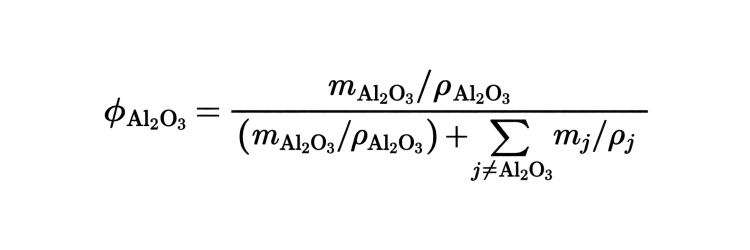
Here, (m_a) and (\rho_a) are alumina mass and particle density; the summation covers the remaining constituents. Use consistent units and an explicit accounting basis for the treatment material. The calculation assumes additive constituent volumes and excludes entrained air.
Use particle density rather than loose or tapped bulk density, which includes spaces between powder particles. For mixed fillers, include each solid separately.
Keep binder composition and reactive-component proportions controlled. Adding silicone oil or changing the resin-to-curative ratio to recover flow creates a different formulation and prevents a clean grading comparison.
Check What Changed Beyond D50
Obtain the differential and cumulative particle-size distributions, their reporting basis, D10/D50/D90, a suitable coarse-tail measure and Brunauer–Emmett–Teller (BET) specific surface area. Inspect particle shape as well. Similar median sizes can conceal different fine fractions, coarse tails and morphologies.
A suitable coarse/fine blend can improve packing by allowing smaller particles to occupy spaces between larger ones. Resonac documents spherical alumina grades with narrow, broad and bimodal distributions for resin filling. Its compound-viscosity data are representative results at stated loadings, rather than universal formulation targets.
Surface area creates a competing consideration. For otherwise comparable nonporous particles, reducing size increases area per unit mass. Increasing the fine fraction can therefore improve geometric packing while increasing wetting and treatment demand. BET provides information that D50 alone cannot supply.
Screen a limited series of coarse/fine ratios at constant total alumina volume fraction. Keep powder chemistry, treatment basis and mixing conditions comparable. Report the ratio within the filler blend separately from total filler loading.
A repeatable viscosity minimum identifies a useful blend in that formulation. It does not establish a transferable optimum. If viscosity increases with the fine fraction, investigate surface area, treatment adequacy and dispersion before rejecting the grading approach.
Distinguish Particle Grading From Agglomeration
Particle-size results depend on preparation. Document the dispersion medium, optical model, concentration and dispersion-energy sequence before comparing powders or lots.
Malvern Panalytical distinguishes measurements intended to retain agglomeration information from those intended to resolve dispersed particles. Increasing dispersion energy may separate agglomerates or damage particles; its guidance recommends examining that distinction during method development.
Pair powder characterization with microscopy of representative resin dispersions. If dilution is necessary, check whether it changes the structure being investigated. A well-dispersed particle-size sample does not establish equivalent dispersion in silicone.
Avoid assigning a universal viscosity effect to every particle-size increase. One silicone-potting study observed cluster formation alongside lower precursor viscosity after a deliberately controlled reaction between amino- and epoxy-treated alumina in vinyl silicone oil. The authors proposed a cluster-related lubrication mechanism. This specialized route does not validate uncontrolled production agglomeration.
Use the size and microscopy evidence to identify what structure changed, then test whether that change accompanies repeatable flow behavior.
Verify Treatment Chemistry and Its Measurement Limits
Establish the treatment chemistry, application route, nominal amount, drying history and intended resin compatibility. Pretreated powder and free silane added during compounding are different experimental conditions.
A study of methyltrimethoxysilane-treated alumina demonstrated changes in treatment level and surface energy using complementary methods, while finding that its evidence did not conclusively establish Al–O–Si covalent bonding. Treatment detection, attachment chemistry and useful resin compatibility are therefore separate questions.
Select analytical checks for the suspected difference. Surface-sensitive analysis can support a chemistry comparison. Thermogravimetric analysis can support a treatment-content comparison when sensitivity and background losses are adequate. Compare untreated material and relevant process blanks where available.
If exposure or drying history differs, compare moisture using a suitable powder method. Loss on ignition can include water, organic material and other losses; it is not a water-specific result. The alumina-treatment study by Wang and colleagues illustrates the need to distinguish these contributions.
When changing grading, record active treatment per filler mass and its relationship to measured surface area. The same treatment mass per kilogram does not establish equal nominal coverage per unit area.
For platinum-catalyzed silicones, screen cure compatibility early. Dow identifies several amine-containing compounds among potential inhibitors. Test accessible or residual treatment species in the actual formulation rather than assuming that every amino-treated powder will inhibit cure.
ChemicalCell’s silane selection for filled resins addresses reaction-based choices for other specified thermoset systems. Those choices require separate validation before use in an addition-cure silicone.
Separate Grading Effects, Treatment Effects and Acceptance
The following is a proposed diagnostic design, not a reported ChemicalCell experiment.
Use comparable base powders to prepare four trial conditions. The letters identify experimental conditions, rather than the two components of the potting compound.
| Trial | Particle grading | Treatment state | Comparison supported |
| A | Current | Current | Reference response |
| B | Alternative | Current | Grading change at the current treatment |
| C | Current | Alternative | Treatment change at the current grading |
| D | Alternative | Alternative | Each change evaluated in the presence of the other |
Keep total alumina volume fraction, binder composition, reactive ratios and test timing controlled. Define the treatment basis for each powder fraction. Specify whether the alternative treatment changes chemistry, treatment level or the complete treatment process. If several attributes change together, compare the complete routes without attributing the result to one attribute.
Record actual mixing temperature and energy where measurable. Use independent preparations to assess variation between mixes. If the candidate also changes particle shape, phase or other uncontrolled characteristics, describe the outcome as a grade comparison rather than a unique explanation of packing or treatment chemistry.
Compare Numerical Responses Before Applying Pass/Fail
Define the response in advance: for example, apparent viscosity at a specified temperature, shear rate and elapsed time, using the same conditioning method. Compare group means and variation between independent preparations.
The grading changes are B−A and D−C. The treatment changes are C−A and D−B. Here, each letter represents the mean numerical response for that trial condition on the chosen response scale.
To evaluate interaction, examine whether the treatment effect differs between grading levels, accounting for experimental variation. A repeatable difference between C−A and D−B can support an interaction on that response scale. A pass/fail pattern alone cannot establish it, and a statistical interaction does not identify a molecular mechanism. This comparison follows the distinction between main effects and interaction terms in the NIST/SEMATECH experimental-design framework.
Use the results to select the next investigation:
- B improves flow relative to A: grading is a useful intervention at the current treatment. Compare D with C before extending that conclusion to the alternative treatment.
- C improves flow relative to A: treatment is useful at the current grading. Check residual species and cure behavior before attributing the benefit to improved compatibility.
- Only D meets the flow requirement: retain the combination for application validation. The result is consistent with additive improvements, an interaction or both; numerical comparisons are needed to distinguish them.
- All four responses are similar within experimental variation: revisit loading, binder behavior, sample age and processing. This screen does not exclude effects at other grading ratios or treatment levels.
A successful grading intervention still requires supporting size, shape and surface-area evidence before its benefit is assigned specifically to packing. Keep mixing changes in a separate comparison.
Confirm That Lower Viscosity Solves the Potting Problem
Set application acceptance criteria before ranking candidates. Check delivery consistency and dispensing pressure through the intended equipment, filling of representative clearances, and void content after the specified degassing and cure sequence.
Recheck working time and final cure using methods suitable for the silicone. Compare cured thermal conductivity using consistent specimen preparation, cure state, temperature and test method. Include electrical and adhesion requirements where the application demands them.
Inspect stored filled components for settling and redispersibility. Sample relevant locations rather than relying on the upper layer alone. Lower initial viscosity cannot compensate for inconsistent filler delivery after storage.
Advance a grading or treatment change when its processing benefit repeats and the complete potting compound meets the defined application requirements. If only the combined change succeeds, qualify that combination while keeping its mechanism provisional until the numerical evidence distinguishes the explanations.
The next step is a matched comparison supported by full particle-size distributions, BET data and treatment information. ChemicalCell’s Metal Oxides category provides a material-browsing starting point; a listed alumina requires grade-specific confirmation for thermal potting.
